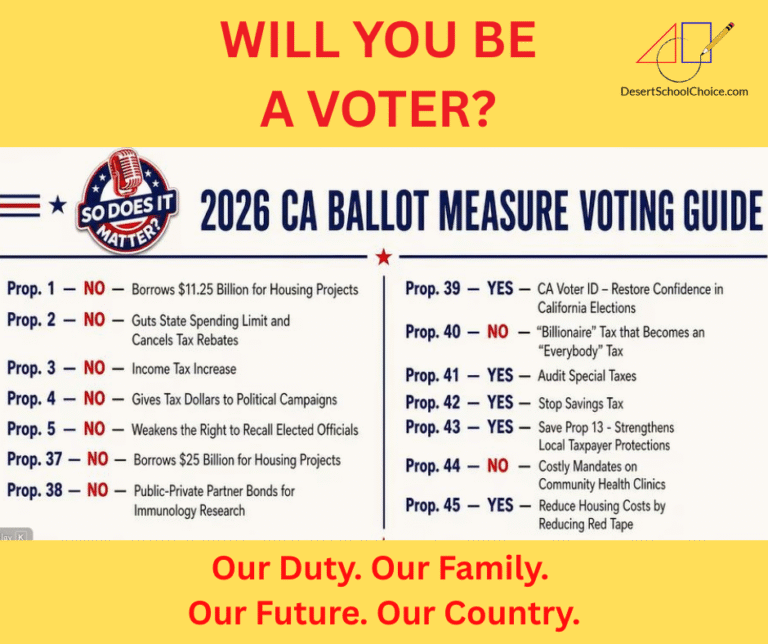
Will you be A VOTER in the November 2026 election? Voter Guide below.
Do you care about your future? Do you care about your children, your grandchildren, your freedoms, and the kind of California they will inherit?
If you do, then I encourage you to exercise one of your most important civic rights: your right to vote. It is our duty.
We all have concerns. We complain about taxes, the cost of living, education, insurance, housing, public safety, and the direction our state and nation are heading. Have we considered how our votes shape the leaders and policies behind these issues?
We cannot expect our voices to shape government if we continually surrender our opportunity to be heard.
Voting is more than filling in a box on a ballot. It is an opportunity to help determine who makes our laws, how public funds are spent, which policies are adopted, and what kind of future we leave for the next generation.
Your vote is your voice. Your participation is your responsibility. Your future is worth your attention.
1. What Are We Actually Voting For?
Our votes help choose leaders who shape our daily lives, from taxes and education to public safety and housing. Elected officials are public servants accountable to the people. Examine their records, qualifications, policies, and willingness to listen before deciding who deserves your vote.
Ask yourself:
- Are our leaders addressing working families’ needs?
- Are taxpayer dollars being spent responsibly?
- Are our freedoms and rights being protected?
- Are parents included in decisions affecting their children?
These are not questions we should ask only when we are frustrated. They are questions we should ask before we vote.
2. Parents, Public Schools, and Our Children’s Future
One of our most important responsibilities as parents is to protect our children’s well-being, education, development, and future.
We must ask important questions about California’s public schools: What are our children being taught? What rights do parents have? How are schools communicating with families? Are parents being included in decisions affecting their children?
California Governor Newsom has passed legislation addressing education, student privacy, mental health, and parental involvement. These laws deserve careful examination so we understand how they affect our families.
According to CaliforniaFamilyCouncil.com, several bills that raise concerns for parents:
- AB 1825: Limits the ability of public libraries to protect kids from sexually explicit material. : Govern Newsom APPROVED 2024
- SB 107 – Established California as a sanctuary state for children receiving gender transitioning surgeries. : Govern Newsom APPROVED 2022
- SB 224 – Requires mental health to be taught in K-12…: Govern Newsom PASSED 2021
- AB 493 – Forcing teachers to affirm LGBT identities and behaviors. : Govern Newsom PASSED 2019
How did these bills reach the Governor’s desk? Read the legislation and examine both supporters’ arguments and critics’ concerns before deciding.
Over the past three decades, have we witnessed the most serious decline in children’s education? Student safety, privacy, and legal protections must remain priorities.
As voters, we must ask candidates where they stand on parental rights, school transparency, curriculum, student privacy, and accountability. .
Leaving your vote to the “smarter folks” to look out for you? Don’t count on it. Stay informed, do your research, and make your voice heard.
3. What Does Human Flourishing Look Like?
Have you ever stopped to ask yourself:
Am I truly flourishing, or am I merely surviving?
Human flourishing means more than surviving—it means living with purpose, enjoying freedom, nurturing relationships, developing your potential, and building a meaningful future.
For families and all citizens, human flourishing means being able to afford a home, live safely, access quality education, pursue meaningful work, practice their beliefs, and plan for the future. It means living with dignity, purpose, freedom, and hope while caring for our families, neighbors, and communities.
The Declaration of Independence speaks of the unalienable rights to “Life, Liberty and the pursuit of Happiness.” In the Bible, Genesis 1:28 speaks of being fruitful and multiplying.
These passages address our responsibilities, our freedoms, and the kind of society we want to build.
So, let us ask ourselves honestly:
- Do California families and citizens have a fair opportunity to flourish?
- Can working people afford life’s necessities and still save for the future?
- Are public policies helping people build stable, productive lives?
- What qualities should we look for in leaders who represent us?
Every family has different concerns. That’s why we must stay informed, check the facts, and take part in our democracy.
4. Liberty and the Constitution: Are We Protecting Our Liberties?
The Constitution limits government power and protects individual liberties through the Bill of Rights, subject to legal limits and competing rights.
The Declaration of Independence, adopted in 1776, affirmed our unalienable rights, including life, liberty, and the pursuit of happiness—principles that remain relevant to American families today.
These principles are more than history. They remind us to consider how freedom, responsibility, and government accountability affect our daily lives.
What does liberty mean to you and your family? It may mean speaking freely, practicing your faith, making lawful family decisions, earning a living, owning property, and participating in public debate without intimidation.
When evaluating candidates, look beyond campaign promises. Examine their records, read the legislation, and consider how their decisions affect our freedoms and communities.
Liberty is worth protecting. It begins with knowing our rights, staying informed, and holding our elected leaders accountable.
5. Over-Taxed, Under-Serviced: California Needs Answers on Our Tax Dollars
Let’s talk about taxes—because we MUST!
Working families face taxes, housing, groceries, utilities, and other rising expenses. We should ask whether our tax dollars are being spent wisely and whether tax policies allow families and businesses to save, invest, and grow.
During the 1980s, President Reagan enacted major federal tax cuts, reducing the top individual income tax rate from 70% to 28% by 1988.
Supporters argued lower taxes encourage work, saving, and investment; critics raised concerns about deficits and revenue. Today, we should ask whether tax policies provide meaningful relief to families while funding essential services responsibly.
This is an example of how government policy can directly affect people’s financial well-being. Today, we need leaders who will pursue meaningful tax relief, manage public funds responsibly, and put the needs of the people first.
Hold elected leaders accountable. Research their records, compare their plans, and demand that they listen not only to careless lobbyists, but to We the People.
6. When Families Need Help Most: Do Leaders Step Up or Look Away?
Imagine losing your home to a wildfire. Your family has lost nearly everything, and now you face delayed insurance claims, rising rebuilding costs, and difficulty finding coverage.
When families are at their lowest, do our government leaders step up to help—or look away?
California families deserve leaders who work to improve insurance affordability and help disaster survivors navigate the road to recovery.
Do the candidates:
- Help citizens rebuild after devastating fires or floods?
- Remove unnecessary delays and obstacles to recovery?
- Take meaningful action to protect citizens after disasters?
When disaster strikes, leadership must mean more than promises. It must mean action, accountability, and a commitment to helping families rebuild their lives.
7. Look Beyond the Headlines—Do Your Research!
Do not vote based on a headline, a slogan, or someone else’s opinion alone. Read, research, and listen!
Read the full descriptions of each Proposition and research candidates’ plans and promises. Listen to both sides, check the facts, and decide what will truly serve the people.
Ask yourself:
- What does this Proposition or candidate actually intend to accomplish?
- How will it affect families, our freedoms, taxes, and our future?
- Who benefits, who pays, and what could the long-term consequences be?
- Is this decision genuinely designed to help the people, and how will it do so?
Do not assume that something is good simply because it sounds good. Likewise, do not reject an idea without understanding it.
Be willing to question, compare, and verify. Look at the facts, consider different perspectives, and determine for yourself which arguments are supported by evidence and which claims fall short.
Your vote is your decision. Make it an informed one. It’s your duty, not a popularity contest.
Our families, our freedoms, and our future deserve more than careless choices. They deserve thoughtful consideration, honest research, and responsible participation.
Remember: Read the Proposition. Research the candidates. Listen to both sides. Verify the facts. Then vote with confidence and a clear conscience.
8. Your Vote Helps Shape the Future of Your Family and Our Culture.
Don’t be discouraged by politics. Without the voice of We the People, officials can make decisions without meaningful public input. Voting gives us a say in who represents us and the policies that shape our future. Not voting means giving up your opportunity to be heard.
Before you vote, ask yourself:
- Does the candidate’s record align with the principles and policies I value?
- Are the candidate’s promises realistic and supported by evidence?
- What are the potential long-term consequences of the candidate’s proposals?
- How might these decisions affect my children, grandchildren, and community?
Vote by looking beyond slogans, party labels, social media posts, and appealing promises.
Learn. Compare. Question. Verify.
TAKE ACTION: WILL YOU BE A VOTER BY NOVEMBER 3, 2026?
Get Your Vote In! Return your ballot by mail by November 1, or submit it electronically by Election Day, Tuesday, November 3, 2026.
Thank you for being A VOTER! Invite a friend, family member, or neighbor to participate, too.
Need to register to vote? October 19, 2026, is California’s voter-registration deadline for the November election. Visit the California Secretary of State’s Elections website to check your registration and find official voting information.
If you’re eligible to vote, make a plan to participate. Check your registration, research candidates and propositions, and verify reliable sources before voting.
As you evaluate your choices, consider filtering each decision through 3-questions:
LIBERTY: Does this choice respect constitutional rights, individual freedoms, and the lawful limits of government?
FAMILY VALUES: How could this choice affect children, parents, household stability, and the well-being of our communities?
FUTURE CONSEQUENCES: What are the likely short-term and long-term effects? What evidence supports the promises being made? Who benefits, who bears the costs, and what unintended consequences might follow?
Don’t wait until a decision affects your family to start paying attention.
Let us pay attention. Let us ask questions. Let us participate.
Your family matters. Your freedoms matter. Your future matters.
CA STATE VOTER GUIDE, visit realimpact.us/voter-guides#Voter-Guides
For a VOTER GUIDE: CA Props Explained, visit, youtube.com/watch?v=CZbS0oZrYNk&is=GJLVI5D7TKnq1CSn
(See video time mark 32:21)
Our Duty. Our Family. Our Future. Our Country.
Sources cites
- 2026 Election: California Secretary of State
- CA Bills (per year): CaliforniaFamilyCouncil.com
- Reagan-Era Tax Relief: U.S. Department of Labor
Contact Us for Education Strategist
DesertSchoolChoice.comSUBSCRIBE & FOLLOW US @DesertSchoolChoice
YouTube.com/DesertSchoolChoice
Facebook.com/
Instagram.com/